Dresses in Bangaladesh
Bangladeshi people wear different types of dresses depending upon their tastes, traditions and festivals. Clothes those we use for attiring is referred as dress.

Bangladeshi people wear different types of dresses depending upon their tastes, traditions and festivals. Clothes those we use for attiring is referred as dress. Different types of dresses are Lungi, Saree, Dhuti, Punjabi, Payjama, Kurta, Sherwani. Both men and women were varieties of dresses. Again, there is a long history of dresses also. At old times, people did not wear the dresses like nowadays. From the writings of medieval writers like Huen-Sang the details of the clothes of that time are known.
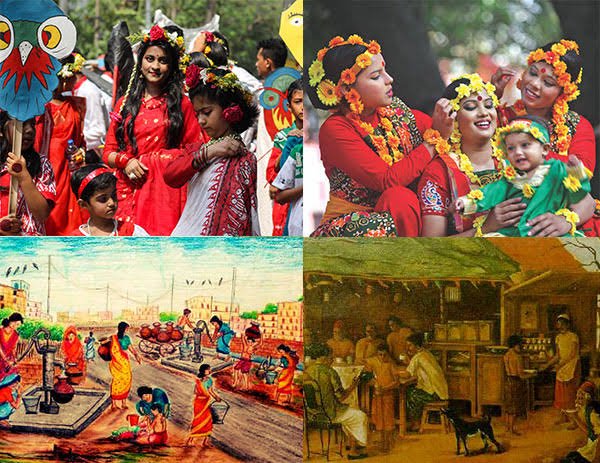
fig: Collected
The excellent terracotta and stones signify the social and cultural life of those times. This terracotta and stones also signify ample light on social conditions of that time. This terracotta and stones were also a source of information of clothes. At that time, women would wear clothes those were held up by cords or girdles and men would wear dhutis those were clinged tightly and shoulder drapes. Huen Sang in his writings described such types of dresses those were not tailored or sewn. Again, men would were white fabrics to get less heat from the sun during summer. Men would pass the cloth under their ampits and wrapp it around their waist keeping it hanging to the rights as well as returning it to drape the torso. On the other hand, women would take the cloth over their shoulders and heads and also wrapped the robes around the body. There was also a great impact of Muslim invaders upon the history of dresses. They would wear a tight fitting trousers, a long coat, a full skirt with tight sleeves. The ruler of that time also wore this type of dresses. There was a noticeable change during the time of Mughal emperor Akbar specially in women's clothes. Women would wear fin-like crown as headgear. Persian influence were seen in Jamdani because of characteristics like embroidered patterns. Again, Muslim male dresses were influenced by the characteristic like archkon or Sherwani.
In 20th century, there had been brought a great change both in male and female dress styles. There had been arrived traditional dresses in respect of culture and festivals or other religious aspects. Bengali men and women were many traditional dresses like Saree, Lungi, Dhuti, Punjabi/ Kurta, Fatua, Gamcha, Sherwani etc. Generally, Bengali males wear shirts and pants most. There are also more classifications in shirts and pants like t-shirts, jeans pants etc. On the other hand, Benagli women wear salwar kamiz more. There are different festivals and cultures in Benagli people's lives. They are such as Durga Puja, Eid-ul-Fitre, Eid-ul-Azha, Pahela Boishakh, Pahela Falgun, wedding and so on. People generally on these special days wear traditional dresses. To say about the characteristic of this traditional clothes, at first, Saree and Dhuti both are basically five to six yards unstitch long clothes. Secondly, Jamdani is made with woven, blend cotton and silk. Now depending on modern demands, different types of design motif are used like lotus, Jasmin Rose etc. Thirdly, Lungi is also our traditional cloth that's shape is tubular and that is 200cm in length and 115 in height. Fourthly, Fatua is a short version of Punjabi and Punjabi is a long dress that ends at ones knee's generally. Fifthly, Gamcha is used more in our country as towel. It is about 2 to 2.5 yards in length and 2.5 yards in height. Thus, dresses of Bangladesh has great varieties depending upon culture, tradition and region.
Written by,
Sonjoy Kumer
Information Collected